Sometimes when I start talking money or financial goals people get a bit nervous. "Oh, I hate to think about the money." Or "Oh I'd rather not discuss money."
But, let's get real, to make money you've got to think about the money. As we learned from The Baby-Sitters Club and Kristy's Great Idea, money comes when you recognize a need and you get organized enough to fill that need.
You don't have to talk about the money with everyone (like I apparently want to do) but you have to find someone (even if it's your accountant or your journal) to talk with about the money. To make a real go of owning your own small business, you have to be realistic about what sort of income you want to be bringing in.
My dad always says that "money is a tool to get things done" and it can really help to think of it like that. Money is not the finish line, money is a tool to keep you participating in the race. I'm not trying to make piles of money so I can stack them up and sit on them. I am trying to generate income so that my family can work towards the lifestyle that we want to live. That's it.
Setting a financial goal for my business in 2011 was a tremendous turning point. Having a dollar goal made it real. This is something real now that I am doing. If I hit my $30,000, I've succeeded. If I don't I have failed. Obviously it's much more complicated than that but it helped me to really see the numbers as black-and-white.
Financial goals also encouraged me to think more about what actually made sense from a money standpoint. I quickly realized that selling sidebar ads for $50 to four-six small shops a month wasn't going to make that big of a dent in my $30,000 goal. I also had to really consider if for $200-$300 a month I was willing to give up my own retail space. Between giveaways and welcome sponsor posts, I was sacrificing my own brand and content for a small percentage of the income I was hoping to earn. In my case, that wasn't worth it. (This was the first sign that I was a business with a blog and not a blog that's a business, you can hear more about this on podcast episode 014b.)
Around this time I remember transitioning towards affiliate programs and away from sidebar sponsors. I vividly remember blogging about a pair of gap shoes and then getting comments and emails that many people had bought them. "Man," I thought. "I wish I had made commission on those sales." I started looking for more affiliate programs that would make sense with my blog.
Thankfully, over the past few years affiliate programs have grown stronger to help support bloggers AND brands. Today I rely on affiliate programs for small but steady income. (You can read more about this here.) For me, this works well since I am always going to be trying and blogging about new things. I'm selective about what I share and I don't think it takes away from my products or "brand" to use affiliate programs. I am careful to disclose these programs (and really everything business related that I do) so that you don't ever think I'm "trying to trick you." Honesty is more important than $$, obviously.
But back to the financial goals. Setting a number to hit also helped me think more logically about my product output. If, for example, I planned to sell a widget that netted me three dollars, I would have to sell 10,000 widgets to hit my goal. Realizing that makes it clear that I would need to drastically improve my reach, raise prices per widget or diversify what I am doing.
In 2011, I knew I'd never net $30,000 on poster prints and mixed paper books alone. So the first big thing that I launched was Blog 2.0, a web design class for TypePad bloggers. I put so much work into that class and I am still proud of it. I priced it at $115 which even now makes me a little nervous. But it sold. My first class was capped at 40 so I could offer one-on-one help and it was a success. I made about $4000 after fees and was beyond thrilled.
That class, with what felt like a very high price point, was a game changer for me. It lead to bigger teaching opportunities in the following years and showed me that taking risks can be worth it. That nervous feeling in the pit of my stomach? That can be a very good thing.
In June 2011, Paul and I were in Palm Desert before he headed off to his first deployment. I remember hitting $15,000 (half my yearly goal) on June 30. We celebrated with mimosas at 9am in the morning. This crazy job? This crazy career path? I might be able to make it work.
Paul deployed in August 2011 and suddenly I had more free time than I knew what to do with. I packed up our beloved San Diego apartment and moved to a new townhouse in Oxnard in December. At this point in my "career," blogging had become second nature. I was easily writing every day and developing editorial calendars quickly. My photography was finding its own groove. I was increasing traffic again thanks to the DIY focus (and pinterest friendly content) of the 26 Projects.
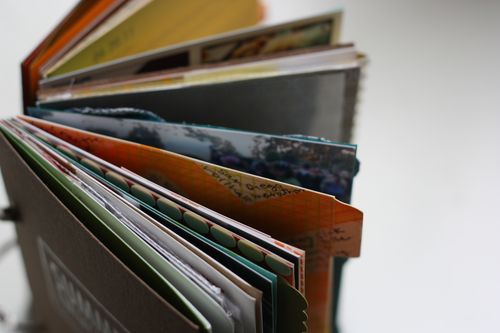
I was still selling on Etsy and my biggest sellers were season-focused mini books that I worked on along-side with customers, often sharing video tutorials (this category is an example). I sold about 250 of my summer books and maybe 150 holiday books. I was experimenting more with product launch hype and created my first video trailer.
When I think back on this time, I was in such a bubble. What I was doing felt totally independent from what anyone else was doing, although I was just starting to meet my online friends in real life. As you've learned from this series, my career has progressed slowly – in part because it's just been me alone and there has been no one else to bounce things off or push me to expand. In many ways I am grateful for this bubble. It's helped me figure out how I work best and what I really like. When I do collaborate with others these days, I feel like I have a stronger voice to bring to the conversation.
After a year of different things: a big online course (and two successful reruns), many (many) mixed paper books, affiliate programs, a deployment and my first big year of sharing DIY projects, I was still in that bubble but had found my grove. I had reached my $30,000 goal and was excited to think 33% bigger in in 2012.
to be continued…read part nine here.

Today on ELISE GETS CRAFTY I am chatting with author, Kim Werker about letting creativity be ugly. Click here to subscribe or stream the episode from your computer here.


 enJOY it
Leave a reply to lisa valinsky Cancel reply