enJOY it

an archived personal and craft blog from Elise Blaha Cripe.

Quilt3

Alright, friends, I had some requests for a full quilt tutorial, so here we go.

Things to know before you start : this is not hard, it just has a lot of steps. If you are comfortable with your sewing machine, you can make a quilt! I will be sharing exactly how I made my triangle quilt, but you can adjust the size, colors or pattern however you would like. I highly recommend reading through this whole tutorial before you purchase supplies and start.

Supplies needed (tools):

Supplies needed (single use):

  • 2 spools of 100% cotton thread (color doesn't matter, this will not show)
  • 2 spools of accent color 100% cotton thread for the backside (mine was lime green)
  • 1 spool of hand-quilting thread (I used white. This color will not show.)
  • 6 different 100% cotton fabric patterns – at least 1/2 yard of each. These will be used for the top of the quilt. Pick fabrics that you love that correspond well with each other.
  • at least 1/2 yard of striped 100% cotton fabric for the binding. I got by with a 1/2 yard, but it was tight.
  • a solid color 100% cotton fabric for the backside. You'll want it to be one piece that measures at least 60×45. I had to purchase from the "quilting back" section to get a large enough piece
  • quilt batting that measures at least 60×45 inches (this is a standard size)

Quiltfabric

step 1 / gather your supplies. I promise, picking the fabric is THE most important thing you will do. This quilt may take awhile and you don't want to hate the fabric colors and patterns by the time you're done. Wash, dry and iron ALL fabric pieces (don't wash the batting). For the record, I ended up not using that light green fabric.
Quilttri

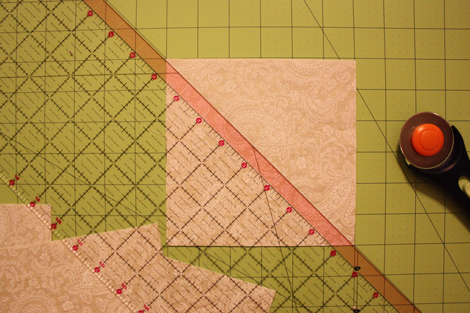
step 2 / begin cutting your six quilt top fabrics into 6 inch squares using your cutting mat, ruler and roller. The best thing about the cutting mat is it has grid lines that are super simple to follow. I cut through two layers of fabric at a time so the whole process goes faster. Once you have squares, cut them on the diagonal (45*) so you now have triangles. I am not sure exactly how many triangles you'll get from each 1/2 yard of fabric, but maximize your fabric space to get the most possible. If you don't feel like being careful about fabric management, be sure to get extra. In total, you will want at least 198 triangles.
Quilttri

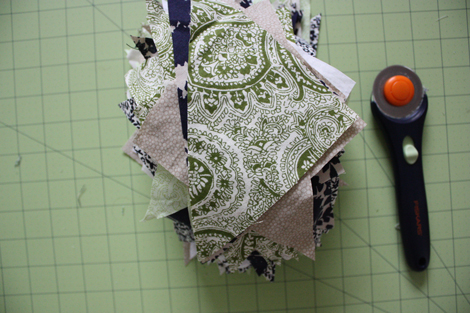
step 3 / congratulations! You have a pile of triangles.
Quiltsew

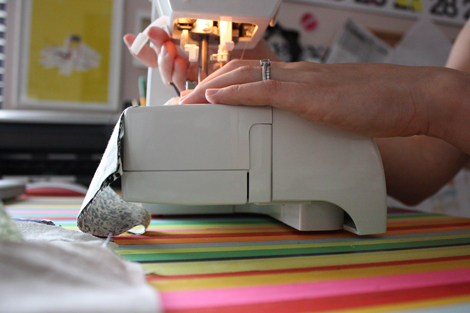
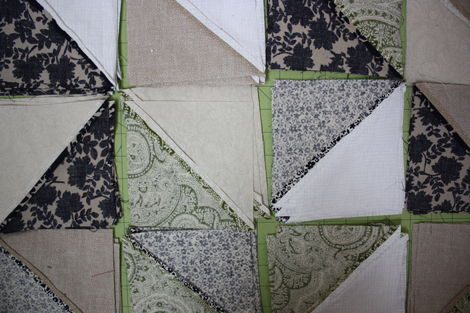
step 4 / sew your triangles together on the long diagonal side. Pair up different fabric combinations. Shoot for the same margin on each edge (probably about a 1/4 inch). I am not precise, and it all managed to work out anyway, but the more careful you are about your margin, the better your quilt top corners will line up down the line.
Quiltiron

step 5 / congratulations! You now have a pile of sewn together squares. Open up your squares and iron out the seam. I folded each side back on itself, but you could also iron them to one side. Trim off the extra fabric "ears" on the corners and hanging thread.
Quiltlayout

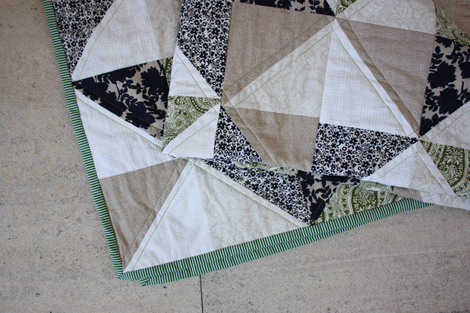
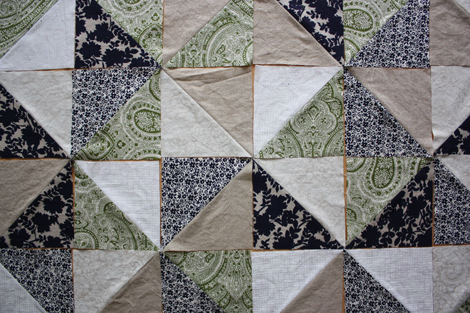
step 6 / on the ground or table, map out your quilt. You should have nine rows of eleven squares. Take a look at how mine are laid out. The diagonals alternate back and forth so what is really being created are larger pinwheel squares. You can decide how much you want color to play in…I like to go for "organized random". Take pictures or do whatever you have to do to remember the order.

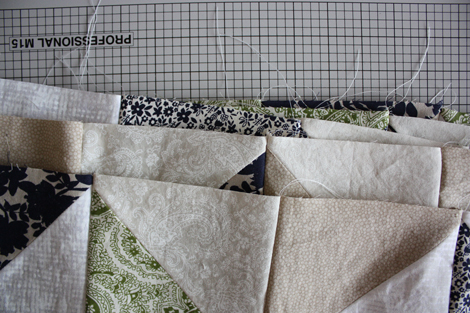
step 7 / pile up your rows so you have nine piles (of eleven squares each). Keeping the rows straight is the only tricky part – or at least it is for me. Make sure you have a method for keeping your stacks in order and begin sewing your rows together.
Quiltstrips

step 8 / congratulations! You now have nine strips of squares! Iron out all the seams again.
Quiltb

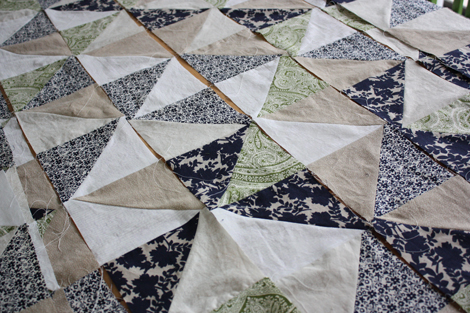
step 9 / lay out all your strips and re-figure out what order they will be sewn together in.

Quiltpin

step 10 / when you have your pattern straight, begin pinning one strip at a time together. (Yes! Pinning! It's time to start lining things up properly.) At this point, you can decide how much of a perfectionist you want to be. If you carefully measured and sewed, all your points will line up perfectly. If you didn't, they won't. Decide how much you want this to bother you and move on.

Quiltc

step 11 / sew the strips together, one at a time, pinning and lining up as you go.
Quiltd

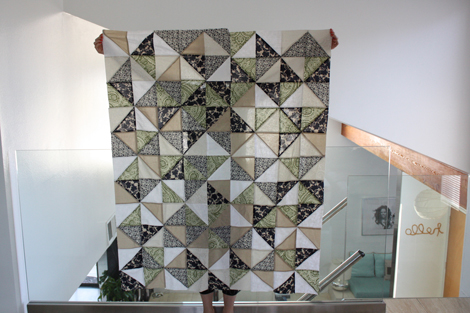
step 12 / congratulations! You how have a quilt top! Iron it all out and trim off any hanging threads.

step 13 / now it's time to sandwich it all together. Lay out your ironed back piece of solid fabric on the floor. On top of that, layer your batting. Take your time to smooth everything out really well. Layer on top your sewn together squares. Again, be careful here to get out the majority of the wrinkles.
Quiltsafety

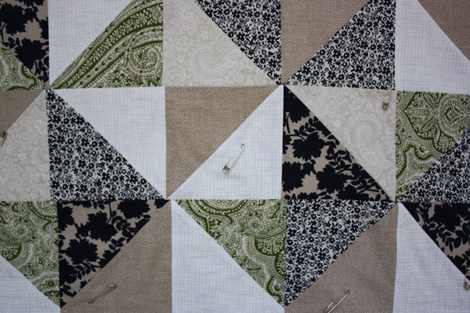
step 14 / start in the center of the quilt and begin safety pinning all three layers together. Put a safety pin through the pieces every 8-10 inches or so. Be sure to get pins all the way to the edges and in each corner. Trim off any extreme excess fabric or batting.

Quiltlayers

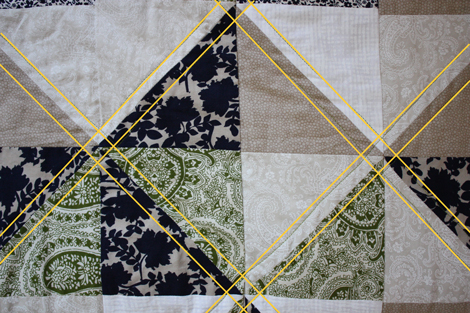
step 15 / take a deep breath because here comes the fun part! Load your machine with your "fun" accent thread. You are going to sew diagonal lines through all three pieces. (One on each side of the diagonal seams.)
Quiltdiagram

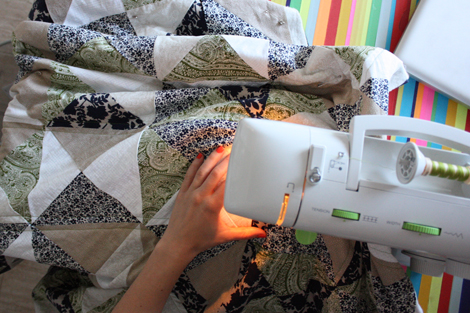
Refer to the diagram above so you're clear. The yellow lines are your stitch lines. Leave the safety pins in as you sew (they'll hold it all together). I don't use anything special, just my normal sewing machine and a bit of patience. It will help to have the stitches on a "long" setting. You may consider getting a walking foot for your machine. Really though, 60×45 is not that big and shouldn't be too much trouble to work with.
Quiltsewing

step 16 / congratulations! You are so close to done!
Quiltborder

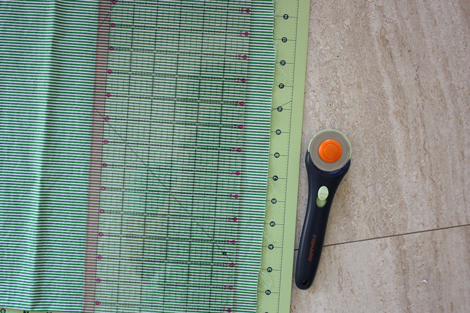
step 17 / cut your striped border fabric. You'll want long strips of three inches wide (with the patterned stripes running horizontal). Sew all of your strips together so you have one long strip (at least 220 inches) of three inch wide fabric.
Quiltfold2

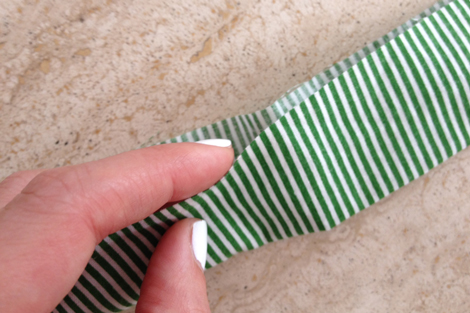
step 18 / fold the long piece of striped fabric in half the long ways. Iron the fold to keep it secure. This folded piece will become the border around your whole quilt.

Quiltborders2

step 19 / pin your long strip to the border of the quilt, taking care to go through all three layers. Start in the middle of a side and work your way around. You'll want the fold of the fabric pointed to the center of the quilt and the rough cut edges to be facing the outside.

Quiltcorners

step 20 / pin all the way around all four edges.
Quiltcorners2

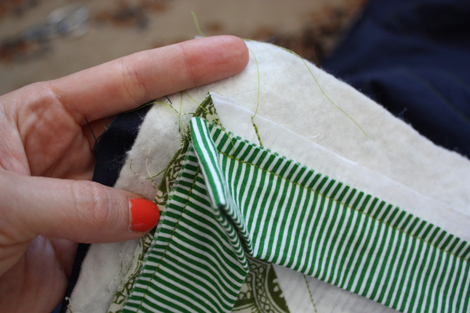
step 21 / machine stitch the border on, taking care at the corners to go in from each side (it should look like the sample above).

Quilttrim

step 22 / trim off all excess fabric layers.
Quiltfolded

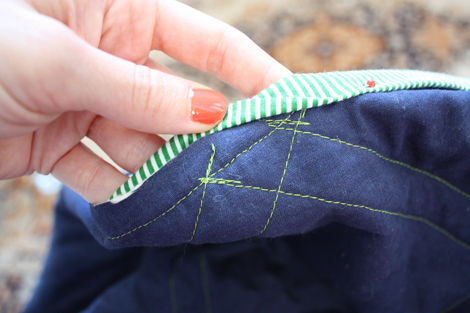
step 23 / fold the border fabric around itself and pin the fold to the backside of the quilt. You will want to use this border to cover up the machine stitches that hold the border on and (if you're like me) the messy backstitching you just created.
Quiltlace

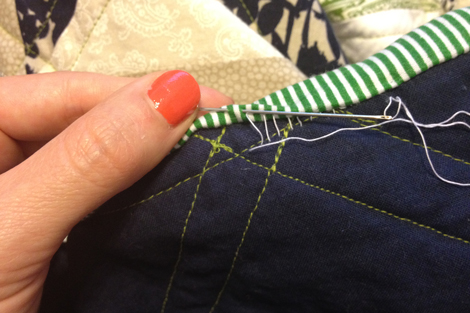
step 24 / time to hand stitch! Load your needle with hand-quilting thread and start stitching. You will want to pull from the underside of the binding and the edge of the backside (do not go through all layers of the quilt, just that solid colored backside). Do a few stitches (it will look sort of like lacing) and then pull it tight. You should not be able to see any thread on either side. It's invisible! Magic!
Quiltpull

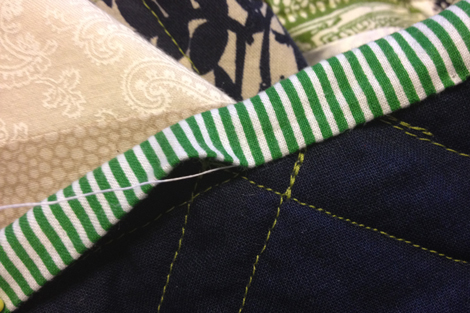
step 25 / keep working your way around the border. When you have to re-thread, knot the two pieces together and hide the knot under the border fabric. I just leave the long tails of thread and let them get hidden by the folded binding too.
Quiltcorners3

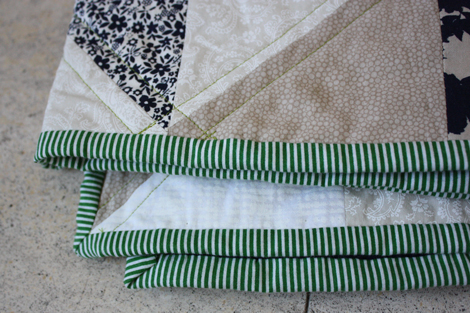
step 26 / the tricky part here is working around the corners. I try to fully secure one side (using the hidden stitching) and then fold the fabric in and layer the other side right on top of it. That's the worst explanation ever, but it just takes some finagling.
Quilt5

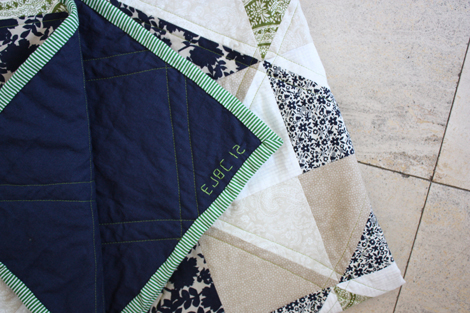
step 27 / you just made a quilt. Time to post a photo to instagram. But first! Add your signature with embroidery floss (be sure to just go through the back layer!)
Quiltwine

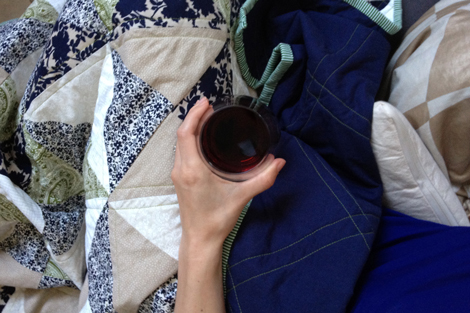
step 28 / sip your favorite drink in under your new handmade blanket.

Hope this helps!! Quilts are my favorite sewing project. And the more you practice the easier (and faster!) the process becomes.

Posted in ,

37 responses to “how to make a triangle quilt!”

  1. Jody R. Avatar

    I have a 1/4″ quilting foot with a guide that I use all the time when sewing quilts. I wouldn’t be able to sew a straight line without it!

    Like

  2. Chelsye Garrett Avatar
    Chelsye Garrett

    Polyester thread isn’t the right kind. You need to use 100% cotton, like your fabric, so they shrink and deteriorate at the same rate. Gorgeous quilt though. I love the color palette.

    Like

  3. CarlyMaria Avatar

    lovely tutorial!! And so straight forward. 🙂

    Like

  4. liz Avatar
    liz

    thanks for this tutorial elise! i’ve been interested in quilting for a long time and you’ve inspired me to finally take the plunge. if i am not very comfortable with my sewing machine would you recommend taking the time to get familiar with it before trying this?

    Like

  5. elise blaha Avatar

    thank you so much for letting me know! I will change the tutorial right now. 🙂

    Like

  6. elise blaha Avatar

    Yes, I would recommend trying some simple things first .. .like maybe cloth napkins? This will help you get a bit more familiar with stitching and sewing. 🙂

    Like

  7. Lindsey Soulsby Avatar

    fun to see the nail polish color change throughout!

    Like

  8. Lindsay Overbey Avatar

    Yay! Thanks so much 🙂

    Like

  9. Skye Avatar

    Wow! Thank you so much for the detailed photos and explanations throughout. Once I get comfortable with a sewing machine, I’d like to return to this tutorial someday and try my first quilt!

    Like

  10. rachel swartley Avatar

    I spent some quality time with my rotary cutter yesterday, cutting up a bunch of old jeans to make a denim comforter. I’m sewing it into a brick pattern, which means I won’t have to worry about getting everything to line up! 🙂

    Like

  11. Lauren Avatar

    So detailed! Love how your quilt turned out, simply gorgeous!

    Like

  12. casey king Avatar

    I use this tutorial for half square triangles. You may be interested. It is super fast, you don’t have to cut triangles, and you don’t have to handle the bias.
    http://www.patchwork-and-quilting.com/grid-pieced-half-square-triangles.html

    Like

  13. Em Avatar
    Em

    I’ve already bought hundreds of euros of pretty fabric… and at some point I will make quilts out of them. I’ll make sure to come back to this post when the times comes. 🙂

    Like

  14. Ali Avatar

    oh yay. thanks so much Elise. I’ve been putting off making a quilt because it seems like such a huge task. but this tutorial makes it seem simpler than what im thinking in my head!

    Like

  15. Sarah B Avatar
    Sarah B

    Hey elise – I’ve been reading (er, stalking) your blog for 6 months or so. I love all the stuff you put up here. What a great tutorial today! I have not made a quilt but I do some sewing for my daughter and a little for myself. If you still want to sew something for yourself I’d recommend this skirt. The pattern is free online and it is fairly simple but produces a super cute skirt! Good luck! http://annamariahorner.blogspot.com/2011/02/flirting-issue.html

    Like

  16. recruitment consultant Avatar

    The craft your doing are amazing. Keep it up. Very wonderful,nice reading this one. Love it!

    Like

  17. elise blaha Avatar

    thank you so much for sharing! excited to try a few clothing pieces these next few months! 🙂

    Like

  18. J3SS1C4 Avatar

    Thank you so much for this tutorial! I’ve been thinking of making a quilt for awhile, and get how to sew the top and the 3 layers together, but no idea at all about the binding. I had a question from your tutorial about it. You mention ironing the binding in half, and stitching it in place… I thought it was folded in half so you could sew one side to the front of the quilt and one to the back, but this looks like you actually sew it while folded so that it is a double thickness if that makes sense?
    Thanks again for the tutorial, it looks like such a fun project!

    Like

  19. elise blaha Avatar

    yes! that is right. That way you can pull the thread through just the bottom (of the folded fabric) and the stitches are invisible!

    Like

  20. alison holcomb Avatar

    thanks for the tutorial elise! a quilt has been on my to do list for a long time now:) love the straight forward directions you gave. my friend and i have a sewing school in rwanda, so hopefully if i can’t figure everything out- our girls can help. love how yours turned out!

    Like

  21. Sam Avatar

    I am so interested in making my own but I will not brave triangles just yet and for my first attempt play safe with squares! Thanks for the detailed tutorial, really helpful Elise!
    Sam
    http://liveandlove.typepad.com

    Like

  22. Dawn F. Avatar
    Dawn F.

    Great tutorial. for those that want a quick project and I know there are tons of them out there – but I love the Fiskars site – the craft section. There are quite a few easy sewing projects and some quilt blocks, pillows that are great for beginners. Also, I’ve always been told to cut the fabric on the bias for the binding but your way is so much easier and faster. Thanks for posting!

    Like

  23. J3SS1C4 Avatar

    Ahh, I get what you mean now!! I’m so going to give this a try once I finish my current knitting project! Thanks again for the tutorial 🙂

    Like

  24. Katie Avatar
    Katie

    I have a ? about the “6 1/2 yards of different fabric.” Because I am such a newbie/ignorant quilter, can you distinguish to me how many different kinds of fabric and how much of each fabric you got? Thanks Elise! I’m so excited to try this out!!

    Like

  25. elise blaha Avatar

    you are right! that does not make much sense at all – I will change the wording. 🙂 You want six different patterned fabrics, at least 1/2 yard of each. 🙂

    Like

  26. kristen Avatar

    This turned out awesome! Will definitely be coming back to this when I finally attempt a quilt (though I should probably try squares before triangles, right?).
    Anyway, great tutorial as always, E! 🙂

    Like

  27. Mariah Avatar

    Such a sweet project! I can’t wait to make one of my own. Thanks for sharing!

    Like

  28. staklene bombone | hard candies Avatar

    yaaay, one day I’ll get there!
    greetings from a sewing starter;)
    staklene bombone | hard candies

    Like

  29. Heather Brittany Avatar
    Heather Brittany

    OMG LOOOOVE!! Want an Alpha Phi/TKE one with old shirts!

    Like

  30. Linda Avatar

    I loved your beautiful baby quilt you did and want to make 2 quilts for my friend having twins 🙂 love it that you happened to make this tutorial! I had no idea 🙂 also love it that you wrote it almost a year ago to the day and especially love it that you wrote it at 5 am 🙂 thank you for this tutorial!

    Like

  31. Wasabi Avatar
    Wasabi

    Hi Elise, I’m excited to start making this quilt, the instructions look really straightforward, but I just wanted to know what’s the size of the finished quilt?
    Thanks in advance!

    Like

  32. bridal mehndi designs Avatar

    If we talk about mehndi designs then these Pakistani mehndi designs for hands 2013 includes the wide variety of designs like floral designs and petal designs. If you want to apply beautiful mehndi designs on your hands then you should apply these beautiful Pakistani mehndi designs for hands 2013. In simple words, we can say that these Pakistani mehndi designs 2013 are very beautiful and stunning.

    Like

  33. Makayla Avatar
    Makayla

    How big is this quilt?

    Like

  34. Barbara Showell Avatar
    Barbara Showell

    I think your polyester thread worked just fine! IF you become a prolific quilter and start showing in shows and selling for megabucks, you may want to get all worried about thread. And many “important” quilters today will use synthetic threads- Aurafil is polyester. The bigger issue with polyester was that (especially years ago)it can be much stronger than cotton, so the threads would actually saw at the fabric and cause the piecing to fall apart after time. We have better thread now than back in the 70’s and it’s not so much an issue. It’s more important to do a quilt or two before you start worrying about the finer details like fiber content. Your tutorial is great for inspiring folks to do that!

    Like

  35. Allison Waken Avatar

    Just found this post (searched it after reading your latest). I’ve had a quilt top sitting around forever because I was too scared to finish off the “sandwich” just going to dive in and do it! Thanks for the tutorial!

    Like

  36. Rachel B DeBacker Avatar
    Rachel B DeBacker

    Bookmarking this! Just kidding. No one bookmarks anymore. That’s what Pinterest is for. Thanks for the tutuorial. I need to get busy!

    Like

Leave a reply to Lindsey Soulsby Cancel reply